News
Equal Justice Works Shares Highlights from the Elder Justice Program
/ Blog Post
As our Elder Justice Program—which placed Fellows across the country to assist older clients who were experiencing elder abuse—comes to a close, read on for program highlights and accomplishments.
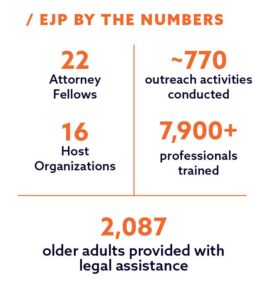
Elder abuse has been referred to as a “hidden epidemic” in the United States, with estimates that 1 out of every 10 people ages 60 and older are victims of abuse like caregiver neglect; financial fraud and exploitation; and psychological, physical, and sexual every year. Equal Justice Works created its Elder Justice Program to mobilize 22 attorney Fellows hosted at 16 legal services organizations nationally to provide trauma-informed civil legal services to victims of elder abuse, particularly in rural areas.

Clients served through the Elder Justice Program reported that they experienced a myriad of legal issues related to financial exploitation, housing, guardianship, domestic violence, identity theft, fraud, public benefits, and more. Many clients experienced multiple forms of victimization simultaneously, requiring trauma-informed and zealous advocacy that Fellows were trained to provide through the Elder Justice Program.
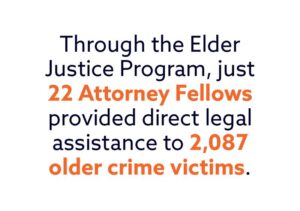 Fellows in the Elder Justice Program successfully increased the capacity of host organizations across the country to address elder abuse by developing a pipeline of lawyers committed to helping older adult crime victims; enhancing multidisciplinary responses to the victimization of older adults; developing community partnerships; and training allied professionals on crime victims’ rights and other topics. Through the Elder Justice Program, a total of 2,087 older crime victims received direct legal assistance from Fellows.
“The [Fellowship] exposed me to different areas of the law, allowed me to work with different kinds of professionals, and granted me the flexibility to design a program that catered to my client’s needs,” said 2020 Elder Justice Program Fellow Elvis Candelario.
To create a broader impact in their communities, Fellows engaged in extensive education and outreach; connected with community organizations to build referral networks; and trained potential victims, volunteers, and allied professionals on topics like elder abuse and crime victims’ rights. As a cohort, they trained over 7,900 individuals through 185 education activities, conducted approximately 770 outreach activities, and thereby increased their communities’ capacity to meet the needs of elder crime victims.
 Fellows additionally trained lawyers at their host organizations on how to respond to situations of elder abuse and detect when elder abuse was occurring within clientele. Their work on sustainable practices and resources will continue to benefit host organizations and communities even after the Fellowship conclusion. For example, a Fellow at Prairie State Legal Services helped create an Elder Abuse and Exploitation Interview Guide to help staff provide trauma-informed services to older adult crime victims. Another Fellow helped build capacity at their host organization by working to finalize an elder law manual, which helps staff identify signs of elder abuse, steps to help clients avoid further abuse, and external services and resources for victims in recovery.
“This experience has been a life-changing opportunity to make a real difference in the lives of individuals who might have otherwise gone unreached,” said 2020 Elder Justice Program Fellow Taylor Amstutz.
This experience has been a life-changing opportunity to make a real difference in the lives of individuals who might have otherwise gone unreached.
Taylor Amstutz /
2020 Elder Justice Program Fellow
Ultimately, an independent program evaluation found that the Fellows’ legal skills and knowledge related to victim legal services increased over the Fellowship program, and many Fellows committed to continue working in public interest law and elder law. In fact, more than half the Fellows accepted staff attorney positions at their host organizations and 21 of the Fellows remain in public interest roles.
We are grateful to all of the Fellows, Equal Justice Works staff members, host organizations, partner organizations, and financial supporters that made this program possible. To learn more about the work of individual Fellows in the Elder Justice Program, click here. To learn more about the current opportunities offered through Equal Justice Works, click here.
This program was supported by an award from the U.S. Department of Justice, Office of Justice Programs, Office for Victims of Crime, Award Number 2019-V3-GX-K033. The opinions, findings, conclusions or recommendations expressed are those of the author(s) and do not necessarily represent the official position or policies of the U.S. Department of Justice or Equal Justice Works.