News
Service, Sacrifice, But No Citizenship: How an EJW Alum Supports Immigrant Veterans
/ Blog Post
During internships in immigration services, Danicole Ramos encountered something that surprised him: veterans who weren’t U.S. citizens. “It really struck me that I never thought this was an issue. I thought once you’re a veteran, you automatically become a U.S. citizen.”
That realization and the gap it revealed became the foundation for his Equal Justice Works Fellowship.
A member of the Hawaii Air National Guard and a child of immigrants, Danicole saw firsthand how immigration and military service intersect in ways that leave veterans without the support they need. Through an Equal Justice Works Design-Your-Own Fellowship, he set out to change that.
Supporting Those Who Serve
While military service can create a pathway to citizenship, the process is not automatic. About 4.5% of the country’s 16.2 million veterans are noncitizens. 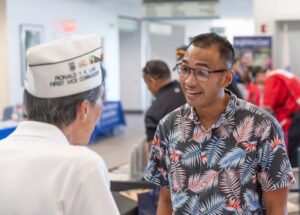
Through his Fellowship, Danicole worked directly with these veterans and began to see patterns emerge. Many had tried to navigate the system but were given incorrect information or lacked the support to follow through.
“We ask these people to serve, we ask these people to sacrifice themselves—but we don’t give them the right support,” Danicole said.
We ask these people to serve, we ask these people to sacrifice themselves—but we don’t give them the right support."
Danicole Ramos
Danicole sees the need for legal support partly as a matter of readiness: “Quality legal services play a role because we can’t expect those in service to sacrifice for our country, to put their lives on the line for their country, if other aspects of their life are not going well.”
Beyond readiness, the consequences of not having immigration paperwork in order can be severe. Veterans returning from combat frequently face PTSD and substance use disorder. For noncitizen veterans, these challenges can trigger immigration consequences, even leading to deportation and removal proceedings.
Designing a Solution
Danicole designed his own Fellowship, partnering with William S. Richardson School of Law’s Refugee & Immigration Law Clinic (RILC) to build a project focused on noncitizen veterans and their families. 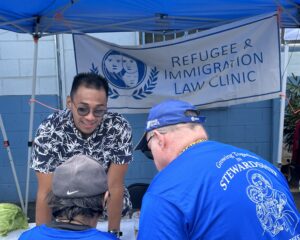
Over the course of his two-year Fellowship, he provided 170 legal consultations on naturalization, adjustment of status, and removal defense. He helped 15 veterans become U.S. citizens and assisted six others in obtaining replacement certificates of citizenship.
The Fellowship allowed him to deliver direct impact legal services and gave him the flexibility to respond to a need that had long gone unaddressed.
A Fellowship Case That Went National
One case brought national attention to the issue.
Sae Joon Park had lived in the United States for nearly 50 years after immigrating from South Korea as a child. He served in the U.S. Army, was wounded in combat in Panama in 1989, and received a Purple Heart. But after returning home, he struggled with severe, undiagnosed PTSD and later faced legal challenges that cost him his green card. 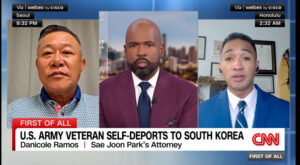
For years, Park rebuilt his life, raising two children and maintaining stability. But in June 2025, he was told his deferred action status had ended. He had to leave the country or face detention.
He self-deported to South Korea, leaving behind his children and his elderly mother with dementia.
Danicole became Park’s attorney and has been fighting for a path home, but it hasn’t been easy.
“Especially for noncitizen veterans who go through the criminal justice system, there’s so many different parts of systems that they have to deal with that are broken, that take a long time, that need to be fixed.” He’s now pursuing a pardon from New York’s governor for the decades-old convictions—a step toward potentially restoring Park’s ability to return.
The case drew national media attention and congressional interest. For Danicole, it reinforced that while attorneys are often focused on how their case will play out in court, the court of public opinion matters too. “When cases have really compelling stories, it can change people’s perceptions and public opinion or open their minds up to different perspectives.”
The Fellowship’s Lasting Impact
Beyond the impact for his clients, Danicole is grateful for what his Fellowship gave him, too. “It really has helped me grow, not just as a lawyer, but as a professional in general,” he said. That included skills beyond the law: community outreach, coalition building, media relations, managing relationships across multiple agencies and stakeholders. 
“It’s made me more grounded in this work, but also helped me realize the bigger picture of what we do as public interest lawyers,” Danicole said. “We’re not just fighting for our client. We’re fighting to address bigger systemic issues in our country, and hopefully reform them, little by little, every day.”
We’re not just fighting for our client. We’re fighting to address bigger systemic issues in our country, and hopefully reform them, little by little, every day.”
Danicole Ramos
Following his Fellowship, Danicole was hired by RILC, where he continues to build on the project he launched during his Fellowship, providing legal services to noncitizen veterans and their families, running naturalization clinics, and overseeing day-to-day clinic operations.
His work reflects the lasting impact of Equal Justice Works Fellowships.
“What Equal Justice Works Fellowships do is they solve problems,” he said. “They give us the opportunity to go on the ground, work directly with the community, build relationships with them, help address their issues—but also use those stories and experiences from the trenches to advocate for bigger systemic changes in the future.”
What Equal Justice Works Fellowships do is they solve problems. They give us the opportunity to go on the ground, work directly with the community, build relationships with them, help address their issues—but also use those stories and experiences from the trenches to advocate for bigger systemic changes in the future.”
Danicole Ramos