News
Advocating For Tenants’ Rights: 2024 Highlights From the Housing Justice Program
/ Updates
In 2019, the Equal Justice Works Housing Justice Program began with eight Fellows serving in Richmond, Virginia with the goal to make housing justice more accessible for the community. Since then, the program has expanded throughout Maryland, South Carolina, and Virginia to provide services for communities facing housing inequity. From 2022-2024, the Housing Justice Program mobilized 23 Attorney Fellows and 9 Organizer Fellows and bolstered the bandwidth of host organizations in their states.
“Fellows in the Housing Justice Program are filling a vital service gap in the communities they serve,” said Laura Roach, senior program manager for the Housing Justice Program. “In most states, renters don’t have the right to an attorney when they are at risk of losing their homes to eviction even though the stakes are so high. The Fellows are really passionate about their clients and have helped thousands of families who would have otherwise faced housing court alone. Partner organizations even estimate the Housing Justice Program has doubled eviction representation in South Carolina.”
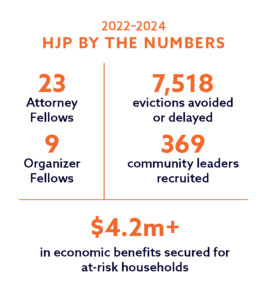 This cohort of Housing Justice Program Fellows helped 7,518 households avoid or delay evictions through direct legal services, provided one-on-one resident services to 5,722 households, trained 8,868 community members about tenants’ rights, and conducted outreach to 29,482 households. Attorney Fellows played a critical role in helping families retain their homes—through brief service, legal advice, and extended representation. They secured over $4.2 million in economic benefits for households at risk of displacement.
For example, Fellow Jamesa Parker helped a single mother avoid wrongful eviction due to incorrect and fraudulent paperwork filed by the children’s father. Additionally, due to Jamesa’s zealous advocacy, the client was reimbursed for mischarged rent, allowing her family economic relief.
Organizer Fellows also made key contributions by connecting residents with legal services, sharing valuable resources, building trust in the community, and mobilizing tenant households to support systemic change. During the grant period, organizer Fellows recruited 369 community leaders and supported 176 large tenant gatherings to discuss resident challenges and mitigation. They also facilitated 61 political education sessions with 570 tenants and secured 302 media placements to raise public awareness.
One tenant shared their experience working with Organizer Fellow Marianela Funes hosted by Tenants and Workers United. “There are a lot of organizations that don’t actually listen to us or help us. But thanks to [Tenants and Workers United (TWU)], they have elevated our voices and stories,” said a community member of a Fairfax County tenant association. “TWU’s programs bring a lot of benefits, but most importantly we gain knowledge and awareness of what goes on in our community and how we can come together. I have learned more about my rights to be able to protect myself. Through our efforts, I hope to find effective ways of getting our local leaders to listen to us and our perspective as immigrants.”
Tenants and Workers United’s programs bring a lot of benefits, but most importantly we gain knowledge and awareness of what goes on in our community and how we can come together. I have learned more about my rights to be able to protect myself.
Anonymous Tenant /
Aided by Organizer Fellow Marianela Funes
Tenants and Workers United
Collectively, Fellows also influenced many policies and court practices related to rent stabilization, rental licensing requirements, increases to eviction filing fees, eviction expungement, record sealing, and improved living conditions for tenants. The impact of these successes will continue to benefit communities even after the Fellowship period. For example, after years of advocacy by tenants, legal services organizations, and Fellows, the city of Richmond, VA allocated $500,000 in its FY2025 budget to pilot a right-to-counsel in evictions program, which will provide a lawyer for a tenant facing eviction if they cannot afford one.
One of the primary goals of the Housing Justice Program upon its inception was to increase the capacity of legal aid organizations by infusing the profession with a cohort of dedicated housing advocates who would continue their work throughout their careers. This is largely proving to be a success with each cohort, as 85% of the 2022-2024 class plans to continue working in a housing-related role. Further, 64% of Fellows reported that they are staying on at their host organizations as staff, and three of those Fellows will supervise the new class of Equal Justice Works Fellows at their organization.
When asked about the Housing Justice Program’s ability to set Fellows up for success, one Fellow said: “I felt extremely supported by Equal Justice Works staff and really relished my connections with other Fellows. I felt professionally supported through the trainings, conferences, and Fellow calls made available in the program and would definitely recommend other young lawyers and recent grads to pursue [this opportunity].”
I felt extremely supported by Equal Justice Works staff and really relished my connections with other Fellows. I felt professionally supported through the trainings, conferences, and Fellow calls made available in the program and would definitely recommend other young lawyers and recent grads to pursue [this opportunity].
Anonymous /
2022-2024 Housing Justice Program Fellow
Moving forward, Equal Justice Works is thrilled to continue supporting the impact of the Housing Justice Program by strengthening our presence in Maryland and South Carolina. With investments from Maryland Legal Services Corporation, the South Carolina Bar Foundation, and several other private foundations, 15 Fellows will begin their projects at host organizations in Maryland and South Carolina in 2025.
Visit here to read more stories about the work of our Housing Justice Program Fellows and how they are advocating for policies and practices that protect the rights of all tenants.
The Housing Justice Program includes Fellows hosted across Maryland, South Carolina, and Virginia. The Housing Justice Program is made possible thanks to the generosity of The JPB Foundation, JPMorgan Chase & Co., Abell Foundation, Community Foundation for a greater Richmond, Maryland Legal Services Corporation, and Sisters of Charity Foundation of South Carolina.