News
The Legal Legacy of Hurricane Katrina
/ Blog Post
By Karen A. Lash, former Equal Justice Works Vice President of Programs, board member, Leadership Development Training speaker, consultant, and student organizer
Hurricane Katrina’s landfall on August 29, 2005, brought not only physical devastation but also an avalanche of legal needs, exposing a critical gap: Who helps survivors navigate the complex legal challenges that follow disaster?
In the aftermath of the storm, I supported efforts to deliver legal help to the people who needed it most and to push for a more equitable recovery. These combined efforts jumpstarted Equal Justice Works’ disaster resilience work, which continues today, and helped lay the foundation for what is now known as disaster law.
Action after the storm

Katrina devastated the southern half of Mississippi, destroying or rendering uninhabitable most of its housing stock. A staggering number of legal needs emerged. First came the immediate issues related to Federal Emergency Management Agency (FEMA) benefits, insurance claims, and housing. Then came secondary challenges: contractor fraud, custody disputes when families were displaced across state lines, and more.
The legal infrastructure was overwhelmed. Roughly half of Louisiana Bar Association members were displaced, with some attorneys working out of tents or cars after their offices were destroyed.
Equal Justice Works heard these legal horror stories and mobilized to get a squadron of lawyers to the region. At the time, I was working for the Mississippi Center for Justice, and Equal Justice Works enlisted my help in finding legal aid offices where Fellows could assist.
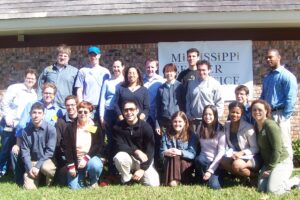
Within six months of the storm, 19 Equal Justice Works Katrina Fellows were on the ground!
The Katrina Legal Initiative soon expanded into three components, all hosted by nonprofit legal aid organizations across the Gulf Coast:
- Katrina Legal Fellowships — two-year placements for experienced attorneys,
- AmeriCorps Legal Fellowships — nine- to eleven-month placements, and.
- Summer Corps — internships for first- and second-year law students.
Together, these programs served more than 17,000 individuals, mobilized over 5,000 volunteer attorneys and law students, and forged hundreds of collaborative partnerships among organizations.
Systemic wins
But numbers tell only part of the story. The Fellows didn’t just represent individual clients — they fought for systemic reforms that affected hundreds of thousands more.
One such effort was led by Reilly Morse, a 2006 Equal Justice Works Katrina Fellow at the Mississippi Center for Justice, where I was also working. I witnessed firsthand his masterful advocacy in the battle to restore housing to Katrina’s most vulnerable survivors.
When Mississippi secured $5.4 billion in federal housing recovery aid, the initial joy gave way to despair as so many elderly, low-income, and minority communities were systematically deprived of the rebuilding funds available to disproportionately white and middle-class victims. When the state declared the recovery “over” and moved to divert nearly $600 million of disaster grants to expand the Port of Gulfport, we at the Mississippi Center for Justice took the fight to Washington.
Once Mercedes Márquez, the newly confirmed U.S. Department of Housing and Urban Development (HUD) Assistant Secretary for Community Planning and Development, got involved, things began to change. Reilly, working with her and her team, led negotiations that ultimately required Mississippi to set aside $132 million — later growing to more than $210 million — for low-income households who needed it most.
This was just one win among many. Through individual representation, class action litigation, and policy advocacy, the Katrina Fellows stopped FEMA from clawing back survivor benefits, secured accessible housing for disabled victims, and reformed federal disaster assistance programs.
Building on Katrina’s lessons
What began as an emergency response evolved into a regional and national collaboration among legal aid organizations, law schools, and law firms providing pro bono aid, leaving a legacy that reshaped how the legal profession approaches disaster relief.
The Katrina Legal Initiative not only created a more equitable recovery from the hurricane — it also informed the first guidebook for delivering legal services in disaster-affected communities and established a replicable model.

Today, the Equal Justice Works Disaster Resilience Program places Fellows and Student Fellows in disaster-prone areas throughout the country, building capacity for both preparation and response.
As natural disasters grow more frequent and severe, Katrina’s legacy reminds us that disaster law is not just history but a living practice. Through the Disaster Resilience Program, the audacious goals born in the storm continue to guide Equal Justice Works and its legal aid and pro bono partners in creating real change for real people when it is needed most.